Newsletter No. 12
Newsletter No. 12 brings you the latest updates from NETmicroplastic, including a biodegradation study conducted in Lower Austria and an overview of Austria’s Microplastics Action Plan, its implementation report and key achievements. We also introduce recently launched European projects focusing on biodegradable agro-delivery systems, seed coatings and plant protection products.
These projects have also been added to the NETmicroplastic Database. We welcome your suggestions for further relevant entries related to microplastics and biobased materials in agriculture and soil health. Please feel free to contact us at info@net-microplastic.eu.
Finally, this issue highlights upcoming conferences addressing the environmental impact of microplastics, analytical methods, innovative prevention and remediation solutions, and bio-based and biodegradable materials.
Testing Biodegradable Products Under Real Soil Conditions
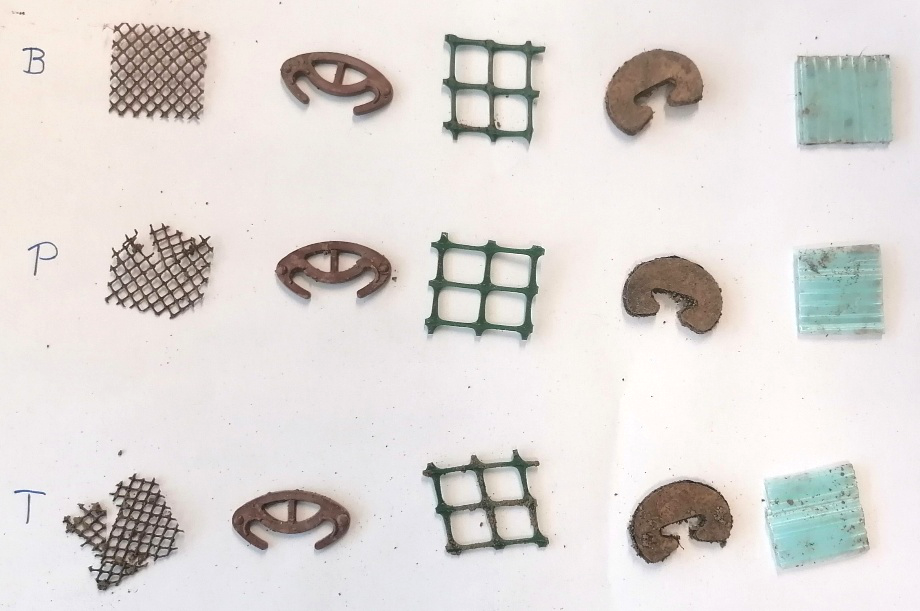
In February, we launched a field study to investigate the biodegradation of three biodegradable products alongside two conventional products in three different soils across Lower Austria.
The tests were conducted in farmland in Tulln, a home vegetable garden near St. Pölten, and a home lawn in Bruck an der Leitha, each with distinct soil characteristics, nutrient levels and microbial activity.
After nine months, the key finding was clear: only one of the three biodegradable products – a brown biodegradable mesh vine guard – had disintegrated. The two biodegradable clips showed no signs of disintegration.
Following the hot, dry summer, observations showed little change compared with June. However, the extent of disintegration varied considerably between locations: the mesh vine guard disintegrated in Tulln (Alkaline soil, high potassium (K) and phosphorus (P) content, and high microbial activity) and near St. Pölten (Alkaline soil, sufficient K, very high P, and moderate microbial activity), but showed no signs of disintegration in Bruck an der Leitha (alkaline soil, low K and P levels, and moderate microbial activity).
These findings highlight that biodegradability depends not only on a material’s composition but also on its environment. Soil properties, nutrient availability and microbial activity can all influence how materials break down over time. Real-world field tests are therefore essential to understanding how biodegradable products behave beyond controlled laboratory conditions.
Austria’s Microplastics Action Plan 2022–2025: Key Achievements and Progress
The Microplastics Action Plan 2022–2025 Implementation Report has now been published by the Austrian Environmental Agency, documenting Austria’s progress in tackling microplastic pollution. It highlights 72 activities involving research institutions, public authorities, industry and NGOs at national, European and international levels, implemented under 25 measures across five action fields. Key achievements across the five action fields (AF) include:
AF 1: Strengthening the Evidence Base, Research and Innovation
Research and innovation represented the most active area, with 51 reported activities. Austrian institutions strengthened their expertise in detecting and analysing microplastics and tyre wear particles, contributing to the development and harmonisation of analytical methods for water, soil, compost, food and human samples. Research also advanced the detection of smaller particles, including nanoplastics. However, further progress is needed to establish reliable, cost-effective and harmonised monitoring methods.
Efforts also focused on developing alternatives to conventional fossil-based plastics, including cellulose-based products, biodegradable mulch films, packaging and coatings. Research into the environmental and health impacts of micro- and nanoplastics improved understanding of their uptake and biological effects. Nevertheless, direct links between exposure and specific human diseases have not yet been established.
AF 2: Effective Implementation and Advancement of Regulations
Austria actively contributed to European legislation addressing plastic pollution throughout the plastics life cycle. This included measures targeting problematic plastic additives, microplastics under REACH, plastic pellet losses, tyre wear and wastewater emissions. At national level, the planned phase-out of agricultural sewage sludge from larger wastewater treatment plants from 2033 and the introduction of a deposit-return system for plastic bottles in January 2025 represent important steps towards reducing pollution and improving resource recovery.
AF 3: Awareness Raising – Consumers and Schools
AF 3 aimed to reduce microplastic pollution through long-term behavioural change, targeting consumers, young people and specific stakeholder groups through awareness campaigns, public events and educational activities. Initiatives promoted alternative practices in sports, agriculture and forestry and encouraged stakeholder exchange.
Education ranged from classroom experiments and university modules to mobile laboratories, escape rooms and citizen science projects, actively involving young people in research and awareness raising.
Waste prevention and anti-littering campaigns addressed the persistent challenge of littering and plastic fragmentation. Citizen science apps helped identify littering hotspots, while nationwide clean-up initiatives mobilised tens of thousands of volunteers annually, removing hundreds of tonnes of waste. Specific campaigns and enforcement measures also targeted cigarette butt littering.
AF 4: Voluntary Measures
Voluntary initiatives complemented regulation and often anticipated future legislation.
Austrian Ecolabel: Set standards beyond legal requirements, excluding microplastics from labelled products before the EU REACH restriction and promoting plastic-free fertilizers, circularity and reduced single-use plastics.
Pellet loss prevention: Through the Zero Pellet Loss Pact and Operation Clean Sweep®, Austrian companies introduced technical measures, employee training and certification. Their experience contributed to EU-wide binding measures adopted in 2025.
Artificial turf: Since 2022, Austrian sports funding bodies have stopped supporting artificial turf with rubber granulate infill, anticipating the subsequent EU-wide REACH restriction.
AF 5: Austria’s Contribution to Global Sustainability
Austria actively supported international efforts to address plastic pollution and associated chemical risks. Contributions included work under the Stockholm and Basel Conventions and participation in negotiations towards a legally binding Global Plastics Treaty addressing the entire plastics life cycle.
Looking ahead
Despite considerable progress, microplastic pollution remains a complex challenge requiring continued research, effective regulation and cooperation across sectors. Priorities include improving monitoring methods, reducing emissions from tyre wear and wastewater, preventing plastic contamination in agriculture and composting, and developing safe, sustainable alternatives to conventional plastics. The experience gained through the Austrian Microplastics Action Plan provides an important foundation for further action towards a cleaner environment and a more circular plastics economy.
Recently launched European projects addressing plastic-free delivery systems
Generating sustainable, Responsible, Effective, and Eco-frieNdly delivery systems for fertilising products
1.10.2026 – 30.9.2030
GREEN will develop 20 multiscale bio-based and biodegradable delivery systems (BBDS) for fertilisers, based on coatings, porous scaffolds, microencapsulations, and molecular complexes. These systems will be designed to deliver macro- and micronutrients, protect microorganisms, and stabilise biostimulants, respectively. They will be integrated into 10 modular systems adapted to wet and dry climates, which are optimised to 6 hierarchical end-products under laboratory, greenhouse, and field conditions. The modular design enables synchronised nutrient release and integration of various actives, with adaptability to conventional and organic farming, as well as seed and plant protection. Their performance will be validated through field trials, including organic farming. Guided by a customised Safe-and-Sustainable-by-Design (SSbD) framework under the One Health concept, GREEN BBDS will undergo biodegradability tests in soil, freshwater, and marine environments, ensuring safety for ecosystems and food chains. Through a strong Multi-Actor Approach (MAA), GREEN will involve >100 farmers, cooperatives, and agronomists in co-creation, field validation, and training, building trust and ensuring regional relevance.
Bio-based and biodegradable controlled-release fertilisers for safe and sustainable agriculture
1.9.2026 – 28.2.2030
RELEASAFE will design and demonstrate novel bio-based, biodegradable coatings and controlled-release systems using lignin derivatives, dialdehyde starch, thermoplastic starch, polyhydroxyalkanoates, and wood. The project is based on a threefold approach:
- Sourcing and processing underutilised regional biomass side-streams—including kraft black liquor, reclaimed potato starch, and pruning waste—into advanced, sustainable, and eco-designed biopolymer matrices and structural carriers.
- Optimising material formulations through custom crosslinking strategies and the integration of tailored, latent hydrolytic enzymes that act as biologically responsive triggers to precisely modulate nutrient release profiles.
- Scaling up the selected compliant formulations to pilot level and conducting comprehensive agronomic and environmental validations—including soil health, metagenomic microbiome, and ecotoxicity assessments—in both greenhouse and open-field trials for maize and tomato crops.
Bio-based and Biodegradable Controlled Release Delivery Systems for Agricultural Inputs
1.6.2026 – 30.11.2029
BIOCORDELIA will utilize lignocellulosic biomass derived from underutilized side streams of European agricultural and forest industries to develop fully bio-based and biodegradable controlled release delivery systems. These systems will ensure agronomic efficiency, environmental safety and biodegradability in soil environments. The lignocellulosic materials will be optimized to achieve two different controlled release delivery systems, namely bio-matrix and bio-coating, with tailored release durations of up to 2 and 8 months, respectively. Biodegradability of the materials and their efficacy for nutrient release will be evaluated in detail, with a focus on the factors affecting the biodegradation process and overall soil health, SSbD principles will be employed throughout the project. Multi-actor approach will be implemented to ensure active stakeholder involvement and effective communication, dissemination and exploitation of results.
Upcoming Conferences and Events
5th Microplastic Symposium – “Emerging Microplastics: Sources, Pathways, and Analytical Challenges”
Bergen, Norway | 20 November 2026
Covering a range of topics, including temporal trends in plastic pollution, emerging sources of microplastics, environmental transport pathways and current analytical challenges. Attendance is free of charge, and online participation is possible.
https://www4.uib.no/en/research/events/emerging-microplastics-sources-pathways-and-analytical-challenges
EBC26 – European Bioplastics Conference
Berlin, Germany | 1–2 December 2026
Bringing together stakeholders from across the bioplastics value chain to discuss EU policy developments, global market perspectives and the latest innovations in biobased and biodegradable plastics.
MICROM 2027 – Microplastics in Organic-rich Matrices
Novi Sad, Serbia | 8–9 April 2027
Addressing current scientific understanding of microplastics, nanoplastics and emerging contaminants and innovative approaches to pollution prevention, remediation and environmental sustainability.
Uppsala, Sweden | 25–26 May 2027
Presenting the latest research on the analysis of nano- and microplastics and plastic-associated chemicals in food production and packaging, their potential environmental and human health risks, as well as needed policy developments and implementation measures.
Ljubljana, Slovenia | 28 September – 1 October 2027
Including a broad range of topics related to micro- and nanoplastics, including their preparation and characterisation, monitoring methods, environmental fate and impacts, as well as innovative solutions for tackling microplastic and plastic pollution.