Newsletter No. 11
We share highlights from recent NETmicroplastic activities, including our conference on 6 November as a key milestone of the project, as well as contributions at the final PRIORITY conference in Leoben, MICROM 2025 in Novi Sad and the Viticulture Seminar in Klosterneuburg. We also welcome our new associate members, CIRCE and GO!PHA, and present newly added European projects in our continuously growing (“living”) database. In addition, on behalf of the INSPIRE project, we invite farmers to participate in field testing of PHA films and to provide feedback on their performance and biodegradation. We close by wishing all our newsletter subscribers a relaxing Christmas season and a bright and successful 2026.
NETmicroplastic Conference & minifair 2025: from evidence to action
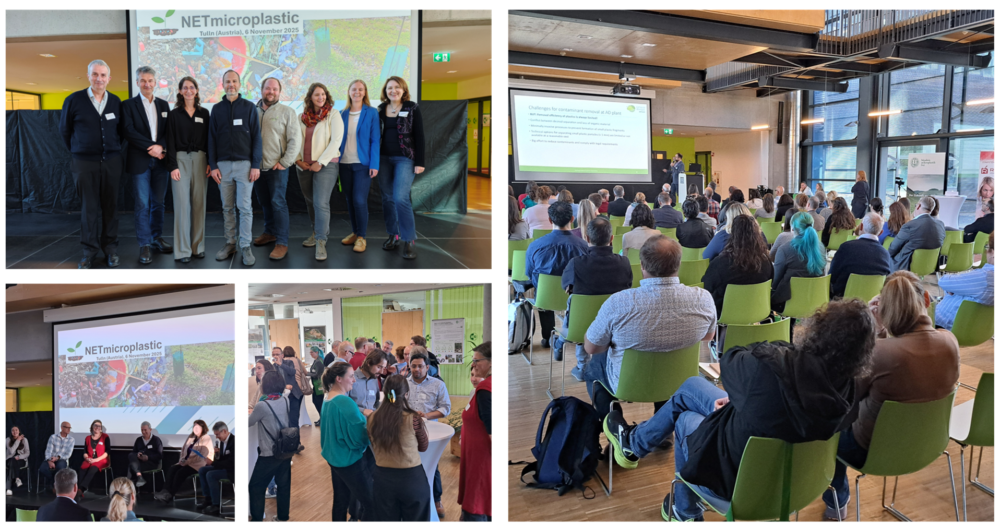
On 6 November 2025, the NETmicroplastic Conference & Mini-Fair brought together experts from science, agriculture, industry, and public authorities at AIT in Tulln. Through a keynote by Christian Lott (HYDRA Marine Sciences GmbH), technical sessions on plastics in agricultural fields and fertilizers as sources of microplastics in soils, an interactive stakeholder tour, and a panel discussion, the event explored key sources, risks, and practical mitigation measures—from agricultural applications and fertilizers to compostable materials.
Technical contributions by Ildikó Heim (FiBL Austria), Amila Abeynayaka (Technical University of Denmark), Ferran Martí Ferrer (Aimplas), Melanie Brait and Florian Brunner (Austrian Compost & Biogas Association), Julia Möller (Wageningen University & Research), and Gabriel Gerner (ZHAW Life Sciences and Facility Management) covered a broad spectrum of topics. These ranged from European field study results and composting processes to biodegradable mulching films and digital decision-support tools for farmers.
Discussions highlighted where plastics provide agronomic benefits—such as soil warming and weed control—and where biodegradable alternatives are essential, particularly for short-term uses or where reliable retrieval is not feasible. European data show that significant microplastic inputs originate from fertilizers (e.g. sewage sludge, compost, manure), while more than one third stems from littering. The links between biowaste collection systems, composting practices, and plastic contamination were also examined. Amila Abeynayaka introduced the upcoming Agriplast Decision Support Tool, which will be available early next year in eight languages and may be further enhanced by AI in the future.
- Have your say: The accompanying survey takes about 10 minutes, and your input helps shape the weighting factors of the tool: https://forms.office.com/e/HUbephxbbd
The stakeholder Mini-Fair showcased innovations in measurement technologies and new materials from across the value chain, presented by Green Legacy GmbH, Lenzing AG, Lactips, Agrana Research & Innovation Center GmbH, ECHO Instruments, RECENDT GmbH, and bündnis mikroplastikfrei.
The day concluded with a panel discussion moderated by Martin Kainz (University for Continuing Education Krems), featuring experts from agriculture, viticulture, research, industry, and public authorities. The discussion focused on real-world challenges and practical solutions for reducing microplastic inputs in agricultural and viticultural systems.
Overall, the event underscored the importance of cross-sector collaboration and reinforced the shared commitment to evidence-based, practical approaches to reduce microplastic pollution in soils.
NETmicroplastic conference contributions
In September we participated in the final PRIORITY conference in Leoben, presenting our findings on “Microplastics in agricultural soils – awareness, knowledge, and biodegradable alternatives”. The conference marked the culmination of a highly collaborative journey by the PRIORITY research network, a science and technology initiative (COST action) dedicated to developing, implementing, and consolidating strategies to address the global challenges posed by micro- and nanoplastics in the environment.
Over four engaging days, participants explored topics such as microplastics analysis, health impacts, biodegradation, and remediation. The sessions highlighted not only scientific advancements but also community engagement, with discussions on citizen participation, advancing plastic pollution monitoring, and networking with external projects.
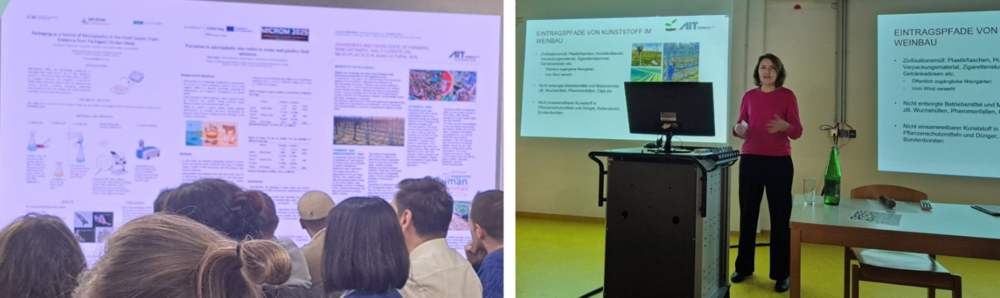
At MICROM 2025 in Novi Sad we presented our poster “Awareness and knowledge of farmers, winegrowers, and students on microplastics in agricultural soil”. The conference program covered three main thematic pillars: analytical approaches for microplastics in organic-rich matrices; sources, fate, and transport of microplastics in the environment; and impact and risk assessment of microplastics and associated additives. The event concluded with a dedicated project networking session, fostering connections between research teams, institutions, and innovators and opening opportunities for collaboration, joint publications, and future partnerships.
Several presentations stood out in particular. Sanja Vasiljević presented innovative work on the coagulation and flocculation of microplastics in different water matrices, offering new perspectives on improving removal processes in natural systems. Giuseppe Suaria shared compelling evidence that even cellulosic fibers do not degrade in deep-sea environments—an important reminder that “biodegradable” does not necessarily mean “biodegrades everywhere.” Rizwan Khaleel explored biofilm formation on microplastics under laboratory and real-world conditions, demonstrating how bacteria and fungi colonize these materials and influence their environmental fate.
Together, these contributions highlighted a crucial message: even well-known biodegradable materials may persist under harsh environmental conditions. To truly understand microplastic behavior and degradation, more real-world studies that reflect the complexity of natural ecosystems are essential.
Beyond the scientific content, MICROM 2025 also showcased a refreshing innovation in conference formats: the ePoster session. Instead of traditional printed posters, sets of three ePosters were presented on parallel digital screens, guided by a moderator who concisely highlighted key messages. Participants could then scan a QR code to access the full poster and directly connect with presenters. This engaging and sustainable approach may well shape the future of poster presentations at scientific conferences.
On 9 December, we presented our findings from the “Survey on the use of plastics in viticulture” at the Viticulture Seminar in Klosterneuburg—an event dedicated to advancing a future-fit, sustainable wine sector. The presentation was held jointly with Barbara Friedrich (HBLA Klosterneuburg), who shared complementary results from an online survey of 78 winegrowers in Lower Austria.
The results show a high level of awareness and uptake: all respondents are familiar with biodegradable alternatives, and 84% already use them, most commonly for binding materials and pheromone dispensers. At the same time, the survey highlighted remaining barriers to broader adoption, notably higher costs and limited practical experience with these newer solutions.
These findings underline both the strong willingness of winegrowers to adopt more sustainable materials and the need for continued knowledge exchange, field experience, and supportive frameworks to enable wider implementation in viticulture.
NETmicroplastic welcomes GO!PHA and Circe Biotech
 Circe gas-based fermentation produces bulk pellets of PHA that can be melted into light plastics, like cutlery, or stretched into films for waterproof paper cups. Being natural, these biopolymers degrade back to their elements, unlike conventional plastics that persist in oceans. The innovation lies in their bacterial library and a late-stage chemical step that suppresses protein growth, forcing secretion of a biodegradable polymer used by nature as an energy store.
 GO!PHA (Global Organization for PHA) unites over 70 stakeholders—including producers, brands, academia, waste managers, start-ups, and environmental organizations—into a collaborative platform that fosters knowledge sharing on circular bio-based materials. By connecting policymakers, industry leaders, and researchers, GO!PHA drives innovation, advocates for supportive policies and investments, and works across the entire material life cycle to deliver sustainable solutions for both people and the planet.
NETmicroplastic database update: new EU projects driving sustainable solutions
Our NETmicroplastic database of research projects, initiatives, and policies has been updated. In this newsletter, we spotlight several EU-funded projects that started on 1 June 2025 and focus on developing bioplastic materials for agricultural use, as well as tools and indicators that link soil biodiversity to ecosystem services.
INSOIL (Safe bio-based and biodegradable IN-SOIL solutions for circular and sustainable crop production) addresses agricultural plastic pollution by developing three families of fully bio-based, safe, in-soil biodegradable products: mulch films, plant guards, and controlled-release fertilizers. Based on sustainable PHA combined with tailored additives, these solutions are designed for climate- and crop-specific, programmed biodegradation
CROPSAFE (Sustainable solution for crop protection against pests) explores innovative, bio-based pest management strategies using residues such as aquatic biomass and spent coffee grounds, in collaboration with biorefinery partners.
Bio4Coat (Bio-based building blocks from biorefinery for advanced coating solutions) aims to validate, at TRL 5, three bio-based building blocks from Novamont’s biorefinery for safe and sustainable coating solutions that perform under extreme and demanding conditions.
UNICO2RN (Flexible and efficient capture and bioconversion of CO₂ to materials and ingredients) combines advanced CO₂ capture using metal-organic frameworks with biotechnology. The project develops modular systems to convert CO₂ into microbial proteins and biodegradable plastics (PHA) in real industrial environments.
Among the more recent projects launched in autumn 2025 are ZELDA and SOUL.
ZELDA (Zero-waste lignocellulose-derived biorefinery products for smart plant protection) is validating a zero-waste biorefinery that transforms agricultural residues into bio-based compounds to stimulate plant defences and growth, including lignin nanoparticles with antimicrobial properties.
SOUL (Bio-based in-soil applications with optimal biodegradation in their ultimate life) focuses on developing novel biodegradable materials with high renewable content, alongside sustainable end-of-life solutions, to reduce soil contamination and support a circular plastic economy.
In addition, the cross-border AgriRePlas (Interreg) initiative aims to reduce the plastic footprint of agriculture by systematically assessing plastic use in fruit and vegetable production and developing targeted solutions such as reusable systems, improved recycling, and safe biodegradable alternatives.
For more details on these and other initiatives, visit the NETmicroplastic database: https://www.net-microplastic.eu/database/. If you believe an important project is missing, we welcome your suggestions for additional entries.
Calling innovative farmers
The alchemia-nova institute is calling on innovative farmers interested in testing biodegradable mulch and greenhouse films, developed as part of the EU project INSPIRE, which aims to reduce plastic pollution in European rivers. These PHA-based films are free from conventional plastics, biodegradable in soil and water, easy to apply using standard agricultural methods, and suitable for crops with a 3–6 month growth cycle. The alchemia-nova institute will provide test materials free of charge—mulch films (1 m wide) and greenhouse tunnel films (2 m wide)—and offer support with their application. Participating farmers are asked to provide feedback on the films’ appearance, durability, field performance, biodegradation behavior, and how they compare with conventional or other bio-based films. If you are interested in contributing to the development of more sustainable agricultural solutions, please contact: panos.petridis@alchemia-nova.eu.